How to Offer a Peptide Therapy Program at Your Business
Learn how to structure, launch, and scale a compliant peptide therapy program

As demand for performance, longevity, and personalized care accelerates, peptide therapy is emerging as a high-impact opportunity for businesses seeking to deliver targeted, clinically guided programs while building scalable, recurring revenue.
But success doesn’t come from simply adding peptides to your menu—it comes from understanding where they fit within your business, which therapies align with your patients, and how to structure them into a cohesive, outcome-driven service.
We’ll walk through how to offer peptide therapy compliantly within your business—covering the structure, clinical considerations, and operational foundations needed to scale.
What Is Peptide Therapy?
Peptides are short chains of amino acids, the same building blocks that make up proteins. The body produces them naturally, and they play a role in a wide range of biological processes, including hormone regulation, immune function, and cellular signaling. Synthetic peptides can also be manufactured in a lab and used in clinical settings.
The Rising Demand for Peptide Therapy
The global peptide therapeutics market is rapidly expanding, growing from $131.9 billion in 2025 to a projected $334.9 billion by 2034 (10.9% CAGR).
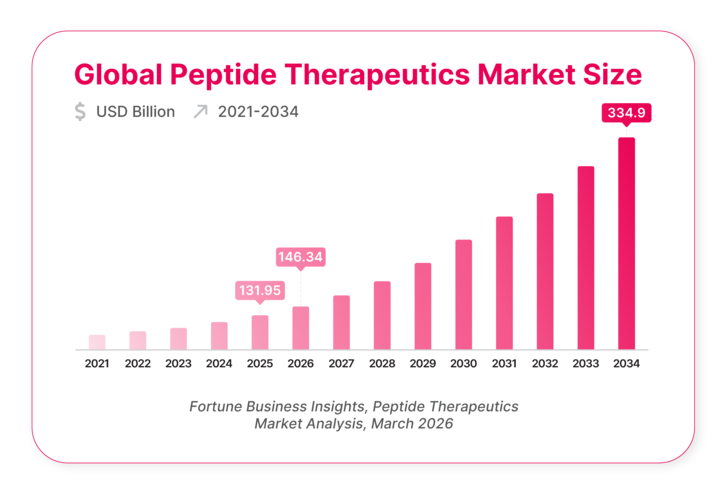
At the same time, interest at the consumer level is accelerating. Searches for “peptides” have increased by 399%, reflecting a sharp rise in awareness and demand.
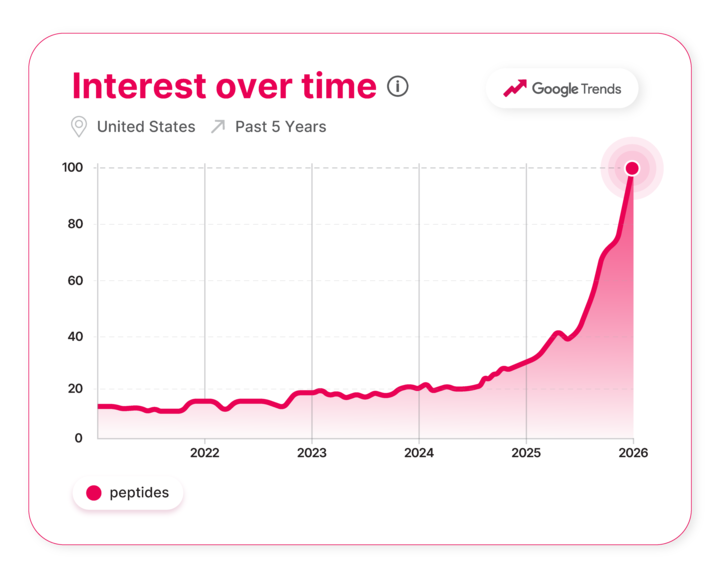
This isn’t a niche trend—it’s part of a broader shift in how healthcare is delivered, consumed, and monetized.
Three structural changes are driving this growth:
A move toward proactive, whole-health models over episodic treatment
Increasing demand for longevity, performance, and optimization-focused services
Expanded access to specialized therapies through more flexible care delivery models
Peptides sit at the intersection of all three and are increasingly being explored across high-demand areas such as recovery, metabolic health, aesthetics, and healthy aging.
What is the current regulatory status of peptides?
There is a lot of chatter in the industry right now about certain peptides potentially being reclassified to FDA Category 1.
At the time of this publication, there have been no regulatory changes. However, the FDA did give a notice on April 15. 2026 that an outside panel of pharmacy advisors will review seven peptides in July 2026. It's important for leaders and executives in the industry to have a clear understanding on where the landscape currently sits and how it is set up. Let's dive into it.
Related Content: Which Peptides Are Becoming Legal in 2026?
Is It Legal to Offer FDA Category 1 Peptides?
Yes, within a defined compliance framework. FDA Category 1 designation opens the door. What happens next depends on how the program is built.
The federal requirements
A valid, patient-specific prescription from a licensed provider is required
Substances must come from a licensed 503A compounding pharmacy (patient-specific) or 503B outsourcing facility
Pharmacies must meet USP 797 standards for potency, sterility, and quality — sourcing from FDA-registered manufacturers
Medical necessity must be documented; informed consent is standard practice for compounded therapies
Where state and federal requirements can conflict
Federal Category 1 status doesn't automatically satisfy state-level rules. A few examples:
California has its own pharmacy board requirements that go beyond federal standards, including additional testing and licensing for certain compounded substances
Supervision requirements vary by state; what a nurse practitioner can independently prescribe in one state may require physician oversight in another
Licensing and shipping restrictions 503A pharmacies must be licensed in each state to ship patient specific medications, meaning some compounding pharmacies may not be able to fulfill orders to every state.
For organizations building multi-state programs, this is an operational reality.
What Peptides Are FDA Category 1?
The FDA’s 503A Category 1 list defines bulk substances that are eligible for patient-specific compounding by licensed pharmacies.
To qualify, substances must meet at least one of the following:
Be a component of an FDA-approved drug
Have a recognized USP/NF monograph or
Be nominated with sufficient supporting data for FDA review
Compounded medications are not evaluated or approved by the FDA for safety, efficacy or quality.
From an operational perspective, this creates a clear—but limited—set of peptide therapies that healthcare organizations can confidently build around.
The FDA Category 1 peptides used in compliant programs today include:
Sermorelin
Clinical role: Associated with endogenous growth hormone pathways through pituitary signaling.
Helps your body naturally signal the release of growth hormone, supporting energy, metabolism, and recovery.
Common areas of clinical focus:
Hormone optimization pathways
Recovery, sleep, and energy regulation
Body composition and metabolic function
Common program use cases:
Patients experiencing age-related decline in energy or recovery
Individuals seeking hormone support without replacement therapy
Gonadorelin
Clinical role: Associated with the body’s hormone production cycle through GnRH signaling.
Helps signal the release of key reproductive hormones, including those that regulate testosterone production and fertility.
Common areas of clinical focus:
Maintenance of endogenous hormone function
Hormonal balance within treatment protocols
Common program use cases:
Adjunct therapy within testosterone programs
Men’s hormone optimization
Select reproductive health protocols
GLP-1 Receptor Agonists
Clinical role: Associated with appetite signaling, glucose metabolism, and energy regulation.
Common areas of clinical focus:
Weight management and metabolic regulation
Blood sugar control
Appetite signaling pathways
Common program use cases:
Structured medical weight management programs
Patients with metabolic dysfunction
Longitudinal care models focused on cardiometabolic health
*GLP-1 therapies follow a related but distinct regulatory pathway (such as patient-specific compounding under 503A or FDA shortage allowances). Because requirements may evolve, organizations should confirm current eligibility with pharmacy partners.
How to Launch a Peptide Therapy Program
Launching a peptide therapy program is not just about deciding what to offer. It requires clear positioning, compliant clinical oversight, operational discipline, and a patient journey built around education and trust.
Here’s a practical, high-level roadmap for business owners evaluating how to start or expand a peptide therapy offering.
1. Define what you’ll offer
Start by deciding which peptide therapies fit your business model, clinical philosophy, and target patient.
For most businesses, that means organizing your offering into clear service lines such as:
Healthy aging and longevity support
Recovery and performance
Metabolic health and body composition
Cognitive wellness and sleep support
This structure helps you make smarter decisions across pricing, operations, and marketing. It also makes your program easier for patients to understand. They’re looking for solutions, not names.
Before you move forward, pressure-test each service line against four questions:
Is there real patient demand for this category?
Can your clinical team support it safely and consistently?
Does it fit your brand and long-term growth strategy?
Can you educate the market clearly without overcomplicating the offer?
2. Choose your care delivery model early
Once your offer is defined, decide how patients will access care. This choice affects everything from staffing and technology to geography and growth potential.
Most peptide therapy programs fall into one of three models:
In-person clinic: Best for brands built around local relationships, hands-on care, or on-site administration
Virtual care: Best for convenience, broader reach, and lower operational overhead
Hybrid: Best for companies that want local credibility with the flexibility to scale digitally
The right model depends on your audience, your operational capacity, and how quickly you want to grow.
3. Build the clinical and compliance foundation first
Peptide therapy is a medical service. That means your program needs licensed clinical oversight, clear workflows, and a strong compliance foundation before you market it.
At a high level, this includes:
Qualified prescribing clinicians
Medical oversight and supervision where required
State-by-state licensure alignment
Standard operating procedures for eligibility, documentation, and follow-up
Clear informed consent and patient education processes
503A pharmacy and fulfillment partners that support compliant sourcing and dispensing
This is where many businesses slow down or create avoidable risk. A strong back-end foundation is what allows you to scale without constantly rebuilding the program later.
4. Secure your pharmacy and fulfillment layer
This step also falls under your clinical and compliance foundation, but requires its own step. In order to offer peptides, you need to be able to supply it and keep up with demand.
At a high level, your program should support:
Prescription coordination with licensed pharmacy partners
Consistent dispensing and delivery workflows
In-clinic administration, if applicable
Coverage across the geographies and patient populations you serve
This step matters operationally, but it also matters for trust. Delays, sourcing issues, or inconsistent fulfillment can quickly undermine the patient experience and create strain on your support team.
You will likely work with a 503A or 503B compounding pharmacy:
503A compounding pharmacies, which are traditional, state-regulated pharmacies that prepare customized patient-specific medications pursuant to an individual prescription under United States Pharmacopeia (USP) standards
503B outsourcing facilities, which are FDA-registered, large scale operations that must follow Current Good Manufacturing Practices (cGMP) and can produce large batches of drugs, with or without individual prescriptions for office use.
You should also evaluate partners based on broader quality and compliance standards, including:
Adherence to USP 797 standards for sterile compounding, where applicable
Potency, sterility, and quality control processes
Sourcing practices and manufacturer standards
Shipping reliability and geographic coverage
The goal is not just to “have a pharmacy partner.” The goal is to build a dependable fulfillment system that supports patient safety, operational consistency, and long-term program growth.
5. Standardize the care journey before you launch
If you want your peptide therapy program to grow, it needs a repeatable care model.
Map the patient journey from first click to ongoing management. At a minimum, define:
Intake and qualification criteria
Baseline assessments and lab requirements
How treatment decisions are documented
Follow-up cadence and progress reviews
Refill and renewal workflows
Escalation paths for side effects, non-responders, or complex cases
Standardization protects quality, improves patient confidence, and makes it easier to train clinicians and support staff as volume increases.
6. Support the program with the right technology
Once the clinical model is clear, make sure the technology supports it.
Your stack should help you deliver a smooth, compliant patient experience across:
Scheduling and intake
Clinical documentation
Secure messaging
Lab and pharmacy coordination
Follow-up and re-engagement
Reporting on program performance
For virtual and hybrid businesses especially, your patient portal matters. It is not just a software decision. It shapes the patient experience, influences operational efficiency, and affects how scalable your program becomes.
7. Launch with an education-first go-to-market strategy
Peptide therapy is still a category where many prospective patients need context before they are ready to convert. That makes education one of your biggest growth levers.
A strong education-first GTM strategy typically includes:
Clear positioning by patient goal
Search-driven educational content
Landing pages by service line
Email nurture and retargeting
Simple conversion paths
At launch, resist the urge to launch everything at one. Start with one or two clear service lines to start, then scale when you see ROI.
The businesses that win are the ones with the clearest positioning, the strongest operations, and the best patient education.
8. Increase patient LTV with recurring care models
Long-term growth should not rely on one-time purchases alone.
Build recurring revenue through:
Memberships
Subscriptions
Program bundles
Depending on your clinical scope, peptide therapy may also create natural pathways into adjacent services like:
HRT
TRT
Weight management and metabolic health programs
Longevity and performance support
Ongoing labs, coaching, and follow-up care
Done well, these recurring care models can increase retention, improve revenue predictability, and grow patient lifetime value over time.
Launch Your Peptide Therapy Program Faster with OpenLoop
Building the infrastructure to launch and scale a peptide therapy program can require significant time, capital, and operational lift—especially when navigating complex, state-by-state regulatory requirements on your own.
OpenLoop has everything already built for you. We provide a faster, more efficient path to market through a fully white-label, end-to-end telehealth infrastructure—eliminating regulatory guesswork and streamlining operations from day one.
With OpenLoop, you get:
Access to compounded medications through licensed 503A pharmacy partners (where permitted by law)
Medically reviewed, repeatable protocols and Medical Director oversight
Licensed clinician network with credentialing and oversight across all 50 states
Compliance-aligned infrastructure designed to adapt to federal and state regulations
Patient support services available 24/7/365
Ready to get started? Contact us today.