How to offer peptides (safely) at your medspa
Expand your medspa’s health and wellness offering with clinician-supported peptide care for longevity and aesthetics.

Peptides are increasingly part of conversations around aesthetics, healthy aging, and wellness. For medspas, that can create an opportunity to give clients more tools to support the health and aesthetic goals they already come to you for.
Are you looking to offer peptide-related care to your medspa? You’re in the right place. We’ll cover what to consider before you launch, what is available to offer today, how 503A compounding works, and how to find the right clinical infrastructure.
Your clients are already searching for peptides
Clients are increasingly looking for ways to support how they look, feel, and age, and many are already researching peptides before they walk through your door.
How fast is interest in peptides growing?
Consumer demand has grown sharply over the years. According to Google Keyword Planner (2021 - 2026), search demand has shot up over the past five years:
Search interest in peptides is up 399% over five years (Google Keyword Planner, 2021–2026).
Searches for Sermorelin, one of the peptides most commonly offered in compliant programs today, rose 233% year over year.
The broader longevity and wellness market sat near $63 billion in 2025 and is projected to reach roughly $106 billion by 2033, according to Grand View Research.
Clients may already be asking your team about peptides, researching them online, or looking for ways to combine aesthetic care with broader health and wellness goals.
What are medspa clients actually looking for?
Depending on your patient population, they may be looking for support around:
Skin and aesthetic health
Healthy aging and longevity
Recovery and tissue health
Body composition and metabolic health
Hormone-related care
Sleep and energy
Broader wellness goals
For medspas, that can create an opportunity to build on the relationship you already have with clients. Peptide-related care can provide additional tools to support goals that may already bring clients to your medspa, from aesthetic and skin health to healthy aging, recovery, and overall wellness.
For a deeper look at the peptides generating the most attention across longevity and aesthetics, see The Most Popular Peptides for Longevity & Aesthetics.
The regulatory state of peptides: What you need to know
If you're considering offering your members access to peptide-related clinical services through licensed healthcare providers, the services available through that clinical model will depend on the medications involved and applicable federal and state requirements.
Bulk substances used in compounding have to meet specific conditions under federal law. For a compounded drug to qualify for the exemptions under 503A, a bulk drug substance generally must:
Comply with an applicable USP or NF drug-substance monograph, if one exists
If the monograph doesn’t exist, be a component of an FDA-approved drug
Or, if neither condition applies, appear on the FDA’s 503A Bulks List.
Separately, the FDA maintains an interim enforcement policy for certain nominated bulk drug substances identified as "Category 1" Category 1 is not part of the statutory eligibility criteria and does not make a substance FDA-approved or or formally included on the 503A Bulks List.
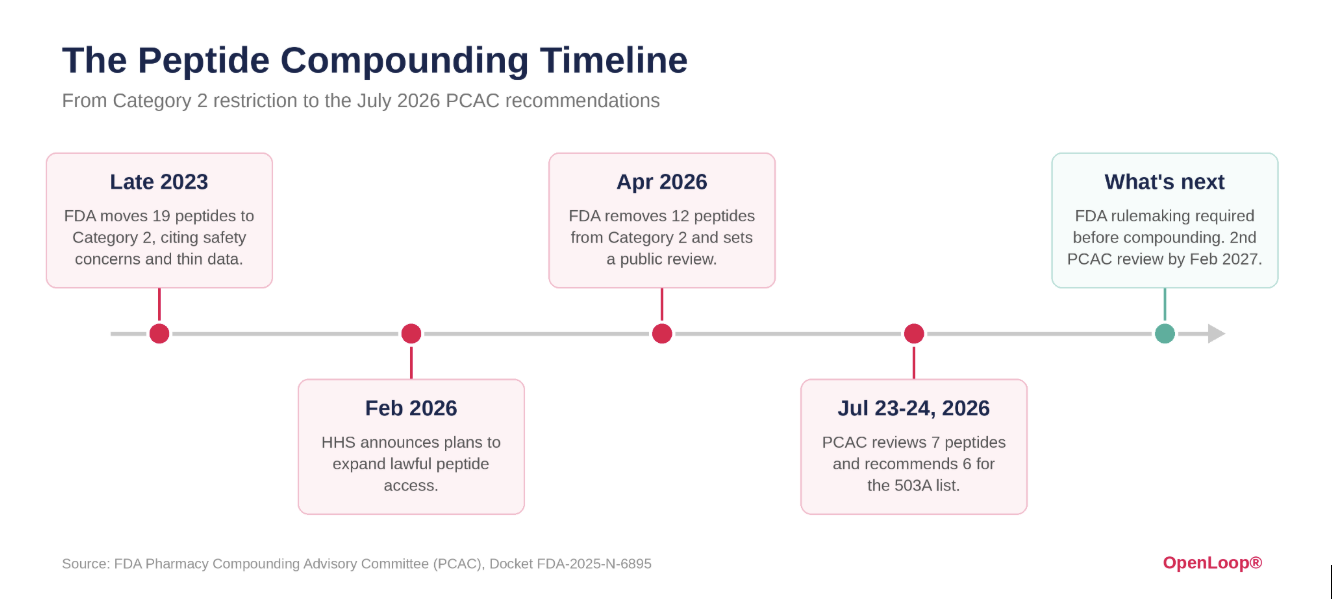
FDA’s regulatory treatment of certain peptide bulk drug substances has changed significantly since 2023. You don't need to be a compliance expert, but you should understand the basics before supporting, promoting, or launching a peptide-related clinical program.
Here's how the last three years unfolded, from FDA’s 2023 category changes through the July 2026 Pharmacy Compounding Advisory Committee (PCAC) votes:
Recommendation does not equal FDA approval
A favorable PCAC recommendation is not FDA approval and does not, by itself, make a substance eligible for compounding under Section 503A.. The committee's votes are advisory and non-binding. A compounded drug made from one of these bulk substances generally cannot be legal unless another pathway applies or the FDA adds the bulk substance to the 503A Bulks List through rulemaking. That process generally includes a proposed rule, a public-comment period and a final rule.
For certain substances nominated before January 7, 2025, the FDA uses three categories to describe their status under its interim enforcement policy. These categories do not themselves establish FDA approval or independently determine legal eligibility under 503A.
What’s the difference between Category 1, 2, and 3?
FDA Interim Category | What it means | FDA's current enforcement posture |
|---|---|---|
Category 1 | Nominated with sufficient supporting information for FDA to evaluate and not preliminarily identified by FDA as presenting a significant safety risk. | FDA generally does not intend to take action when all policy and 503A conditions are met. This is enforcement discretion: the substance is not on the 503A Bulks List, and the compounded drug is not FDA-approved. |
Category 2 | FDA has identified significant safety risks associated with use of the substance in compounding. | Outside the interim policy’s enforcement-discretion policy. FDA has said it would consider taking action against a compounder using the substance under its general enforcement policies. |
Category 3 | The nomination did not contain sufficient supporting information for FDA to evaluate the substance. | Outside the interim policy’s enforcement discretion. |
What does Category 1 mean for prescribing?
Category 1 status does not mean FDA approval, nor does it mean that the substance or resulting compounded drug is safe or effective. It reflects an interim enforcement position under which the FDA generally does not intend to take action against a state-licensed pharmacy, federal outsourcing facility, or licensed physicians compounding with the substance when all conditions of the policy are satisfied.
Those conditions include applicable manufacturer-registration and certificate of analysis requirements, in addition to the other 503A requirements. Category 1 status also does not override state law. State pharmacy, medical-practice, telehealth, prescribing, and compounding requirements must be evaluated separately before a program is offered in a specific state.
Our recap of the July 2026 PCAC meeting discusses the substances considered, the committee’s nonbinding recommendations, and the additional FDA action that is necessary before the substances could qualify for 503A compounding.
How does 503A compounding work?
A 503A compounding pharmacy is a state-licensed pharmacy that compounds patient-specific medications pursuant to valid prescriptions and in accordance with the conditions of Section 503A of the Federal Food, Drug, and Cosmetic Act.
FDA explains that 503A compounders may use bulk drug substances only when the substances satisfy the applicable statutory conditions or fall within an applicable FDA enforcement policy. A compounded drug is not FDA-approved, and FDA does not review compounded drugs for safety, effectiveness, or quality.
What does a peptide program look like at a medspa?
The clinical side of the program should remain with qualified healthcare professionals, while your medspa continues to manage the client experience.
Here's what that typically looks like, although the exact workflow will depend on your clinical model, state requirements, services, and pharmacy relationships.
Client expresses interest. Your medspa introduces the service as an additional health and wellness resource.
Clinical evaluation. The client connects with a qualified clinician who evaluates whether treatment is appropriate based on their health history and clinical needs.
Treatment decision. The clinician determines the appropriate course of care. Your medspa does not diagnose, prescribe, or determine which peptide a client should use.
Pharmacy fulfillment. When compounded medication is appropriate, the prescription moves through the applicable pharmacy pathway.
Ongoing care. The client continues care through the clinical program, and your medspa can continue providing the aesthetic, wellness, and client-support services that complement the broader care experience.
The goal is a clear handoff between your medspa and the clinical team, so clients understand who is responsible for each part of their care.
Build v buy: Pros and cons
You can build a peptide program around your existing clinical team and infrastructure, or use a white-label partner to provide some or all of the additional infrastructure. Let’s explore each path.
| Build in-house | White-label partner |
|---|---|---|
Pros | Potentially greater control over the client experience Existing clinicians and staff may already support some required functions No vendor fees or subscription. | Access to established clinical and operational infrastructure Clinician network and clinical workflows already in place Pharmacy coordination and fulfillment infrastructure Regulatory knowledge Easier path to expanding into additional service lines |
Cons | May require additional providers, staff, technology, or training Increased complexity around clinical workflows May increase operational and regulatory risk More internal resources required and increased operational costs | Less direct control over some clinical and operational processes Requires coordination between your team and the partner Client experience depends partly on the quality of the partner's technology, providers, and support |
How to offer peptides at your Medspa using a white-label telehealth provider
A white-label telehealth partner can provide the clinical, technical, and operational infrastructure behind a peptide program while your medspa remains focused on your brand and client experience. The right partner should be able to support the services you want to offer today and the additional health and wellness services you may want to add as demand grows.
Here are the key areas to evaluate:
Clinical infrastructure and provider network
Why it matters:
The care delivered through a white-label program reflects on your medspa's brand. Your partner should have the clinical infrastructure to support appropriate evaluation, prescribing, documentation, and ongoing care.
What to look for:
Licensed clinicians with appropriate state coverage
Provider credentialing and verification
Clinical oversight and quality processes
Clearly defined clinical workflows
Capacity to support growing client volume
Questions to ask:
How are clinicians recruited and credentialed?
How is clinical quality monitored?
Can the provider network support your target states?
Can the network scale as client demand grows?
Infrastructure that meets regulatory requirements
Why it matters:
Peptide programs operate within a regulatory environment that can vary by state and change over time. Your partner should have systems for monitoring applicable requirements and maintaining compliant clinical workflows.
What to look for:
Multi-state licensure management
Appropriate prescribing safeguards
Regulatory monitoring
Pharmacy coordination
Clearly defined clinical and operational responsibilities
Questions to ask:
Who monitors regulatory changes?
How does the partner respond when a medication's status changes?
How are pharmacy relationships managed?
What compliance responsibilities remain with your medspa?
Scalability and breadth of services
Why it matters:
Your clients' needs may extend beyond your initial peptide offering. A partner that can support additional health and wellness services can give your medspa room to expand without replacing its underlying infrastructure.
What to look for:
50-state clinical network
Capacity to support increasing client volume
Additional health and wellness service lines
Flexible clinical workflows
Ongoing operational support
Questions to ask:
Can the partner support additional states as your business grows?
Can additional service lines be added without rebuilding the program?
How much operational support will your team need to provide?
Technology and client experience
Why it matters:
The clinical infrastructure may sit behind your brand, but your client still experiences the program through the technology, intake process, communications, scheduling, and support provided by your partner.
What to look for:
White-label branding
Easy scheduling and intake
Secure client communications
Integrated clinical workflows
Reporting and analytics
Ongoing client support
The experience should feel like a natural extension of your medspa rather than a disconnected third-party service.
Pharmacy and fulfillment support
Why it matters:
If compounded medication is part of the program, pharmacy coordination becomes part of the overall client experience. Your partner should have a clear process for managing this part of the care journey.
What to look for:
Established pharmacy relationships
Clear fulfillment workflows
Communication around prescription status
Processes for handling pharmacy availability and changes
Clear definition of which organization manages each step
Your partner should be able to explain how pharmacy coordination works and what responsibilities remain with your medspa.
Understand who handles what
Why it matters:
A white-label partner should provide clarity around the responsibilities involved in delivering the program. Before launch, make sure your team understands what the partner manages and what remains with your medspa.
Your medspa may remain responsible for:
Client relationship and brand experience
Making clients aware of available services
Existing aesthetic, wellness, or other services
Coordination with your clinical partner
Your clinical infrastructure partner may manage:
Clinical evaluation
Licensed provider network
Prescribing when medically appropriate
Clinical documentation
Pharmacy coordination
Follow-up care
Clinical and regulatory workflows
The exact division of responsibilities will depend on your program structure and should be clearly defined before launch.
Launch a peptide program without building the clinical infrastructure
Adding peptides doesn’t mean you need to build new clinical infrastructure.
OpenLoop® provides white-label virtual care infrastructure designed to support peptide programs under your brand, including licensed clinicians, clinical workflows, pharmacy coordination, and technology.
Whether you're expanding an existing longevity offering or exploring peptide care for the first time, the right infrastructure can help you add clinician-supported services and meet regulatory requirements without building the entire clinical operation yourself.
Ready to explore peptide care for your medspa? Learn how OpenLoop can help you launch a clinically compliant program.
Compounded medications, including peptide therapies, are not FDA-approved. FDA does not review compounded drugs for safety, efficacy, or quality before they are marketed. Compounded medications require a prescription from a licensed healthcare provider following an appropriate medical evaluation. No prescription or program eligibility is guaranteed; your healthcare provider will help determine whether a given therapy is appropriate for you. Availability varies based on clinical appropriateness, applicable federal and state laws, pharmacy availability, and other regulatory requirements, and not all therapies are available in all states or through all pharmacies. See our website for full details and applicable restrictions.
This content is intended for general informational purposes only and should not be construed as legal advice. For guidance on your specific situation, please consult a licensed attorney.